// project
Job Management System
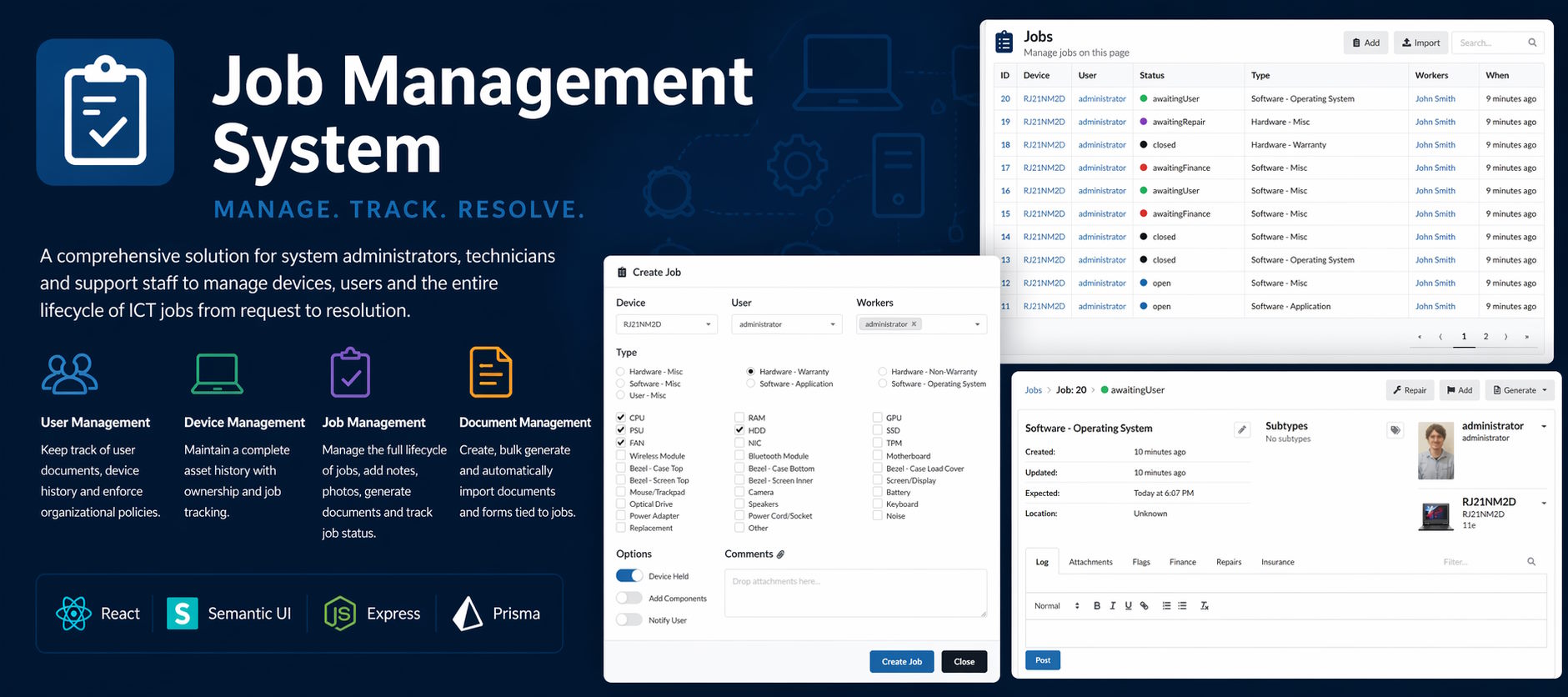
Overview
This ICT Job Management System (JMS) is a full-stack web application designed for system administrators, technicians, and support staff to manage devices, repairs, and operational workflows.
It centralises asset tracking, job lifecycle management, and document handling into a single platform, replacing fragmented spreadsheets, emails, and ad-hoc tools.
The system is particularly suited for school or enterprise environments where devices move through structured repair and support processes.
Key Features
User Management
- Tracks user profiles and associated devices
- Maintains historical records of activity and ownership
- Supports organisational policy enforcement
- Links users to jobs and device history
Device Management
- Centralised asset inventory
- Tracks ownership, lifecycle, and status
- Maintains complete device history
- Associates devices with jobs and users
Job Management
- End-to-end job lifecycle tracking
- Status-based workflow (e.g. open, awaiting user, repair, finance, closed)
- Rich job records with:
- Notes and logs
- Attachments
- Status history
- Assignment of technicians ("workers")
- Categorisation by hardware/software and subtype
Document Management
- Generate documents tied to jobs (e.g. repair quotes, incident reports)
- Bulk document generation
- Automatic import of forms and attachments
- Centralised document storage linked to jobs and users
UI / UX Highlights
Job Dashboard
- Tabular job view with device, user, status, type, workers, and timestamps
- Color-coded status indicators
- Pagination and filtering
Job Creation Workflow
- Structured job creation form with:
- Device and user selection
- Job type classification
- Component-level fault selection
- Worker assignment
- Options for device handling and notifications
- Comment and attachment support
Job Detail View
- Full lifecycle tracking (timestamps, expected completion, location)
- Tabs for logs, attachments, finance, repairs, and more
- Rich text logging interface
Architecture
[ React Frontend ]
        ↓
[ Express API ]
        ↓
[ Prisma ORM ]
        ↓
[ Database ]
Technology Stack
- React
- Semantic UI
- Express.js
- Prisma ORM
- Relational Database
Technical Highlights
- Component-based frontend architecture
- RESTful API backend
- Strong relational data modelling with Prisma
- Status-driven workflow system
- Scalable job and asset tracking
Example Use Cases
- Device repair lifecycle management
- School ICT asset tracking
- Helpdesk / support operations
- Compliance documentation and reporting
Problem Solved
Replaces disconnected tools (spreadsheets, emails, manual logs) with a unified system for:
- Asset tracking
- Job management
- Documentation
- Workflow visibility
Design Philosophy
- Practical and workflow-driven
- Clear lifecycle tracking
- Strong data relationships
- Operator-focused UX